History
The story of Fryerstown School No. 252 — a school for more than a century, and a community hub ever since.
A tent, a church hill and a goldfield (1853–1870)
The Fryerstown National School opened on 6 February 1853 in a tent at the Commissioner’s Camp at Golden Gully, with 27 pupils. The tent could, of course, be moved to where the population was: in May the School Committee recommended moving it to Chapel Hill, where it was later partly destroyed by fire, and in February 1854 it was transferred again to a site near the Commissioner’s Camp — still in a tent.
In April 1855 plans were drawn up, and within a few months a permanent weatherboard building stood next to the Wesleyan (Methodist) Church in Heron Street. A report in the Mount Alexander Mail of 20 July 1855 says:
“I have much pleasure in noticing the opening of the new National School on the hill adjoining the Wesleyan Chapel. The building is by far the neatest in town and reflects great credit on the builder, Mr Moseley Dunn. Entering the township from Spring Gully, we present a very animated appearance to what we did twelve months since. The Episcopal Church, the Wesleyan Chapel (a neat building) and now the National School all stand out in bold relief, as monuments of the English character, that although we may forsake the homeland for the love of gold and accumulation of wealth, we do not forget those better things, the education of our children and the evangelization of those around us.”
Well, the person who wrote that was impressed anyway! The emphasis on neatness is probably a reflection on the makeshift camps and shanties in much of the rest of Fryerstown at the time. Enrolment in 1858 was 30 boys and 44 girls.
The National and Denominational school systems were replaced by the Common School system under the government’s newly formed Board of Education, and Fryerstown National School became Fryerstown Common School No. 252. In 1872, when schooling became free, secular and compulsory, it became Fryerstown State School No. 252.
By that time the local community was faced with increasing numbers of pupils in a building that had been considered unsatisfactory since the early 1860s. In November 1865 the Committee decided a new schoolhouse was needed; written plans and specifications went to the Board in February 1866, and an application for financial aid followed in July. At that time enrolment was 450 pupils — 200 boys, 150 girls and 100 infants under eight years of age.
In May 1868 the school committee, citing the large increase in student numbers, successfully applied for a grant of £50, which they matched to build an additional brick and stone room. It was completed in March 1870. Numbers continued to grow — the schoolroom could accommodate 162 but attendance reached 300 — and the Wesleyan Church school was rented for a year or two until the Department of Education built an additional room in 1874.
The 1915 school (1870–1967)
The saga of maintenance problems went on for another forty-plus years. By 1914 the stone classroom, weatherboard infant room and weatherboard storeroom were beyond repair, and a new school was erected on a site in the centre of Fryerstown.
It is intriguing that the School Committee asked that parts of the old school be moved to the new site and incorporated into the new building, using a low wagon and horse teams. The wooden shingle roof is still evident today under the corrugated iron.
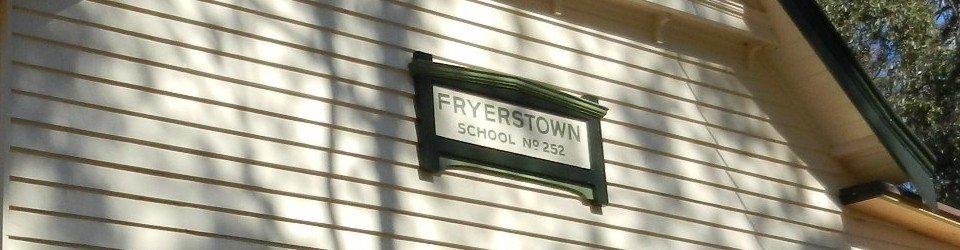
The school was officially opened in November 1915 by dignitaries including the Director of Education, (later Sir) Frank Tate — himself a former pupil of the school — and H. S. W. Lawson, then Minister for Education.
School camps (1967–2003)
The school served the town until 1967, when it closed for lack of students and the last three students were relocated. It remained vacant until taken up as a school camp in 1973 by Gardenvale Central School, later Gardenvale Primary School. The camps ceased in 2003.
They are a significant part of the school’s history because of the large number of city and local students who attended and enjoyed the camps and developed a lasting attachment to the town, its history and its environs. The educational programs they offered were important in the development of environmental education. Those who attended the camps remember them with affection.
Restoration and the reserve today
The Fryerstown Community Reserve Committee of Management was formed in August 2011 under the Crown Lands (Reserves) Act, after the school had been vacant and neglected for a number of years.
Its vision to restore the school, and to build and maintain good and strong relationships through using the school for a variety of purposes, was formed in response to:
- changing circumstances — Fryerstown is an isolated small town experiencing considerable population and lifestyle change;
- community demand — local planning identified the need for a community hub to harness the considerable talent, skill and dedication of long-term and new residents;
- tourism demand — improving accessibility to the Goldfields Track, a walking and mountain-bike trail connecting Ballarat and Bendigo via small towns like Fryerstown;
- interpretive opportunities — providing support for the Victorian Goldfields World Heritage bid focused on the Castlemaine Diggings National Heritage Park.
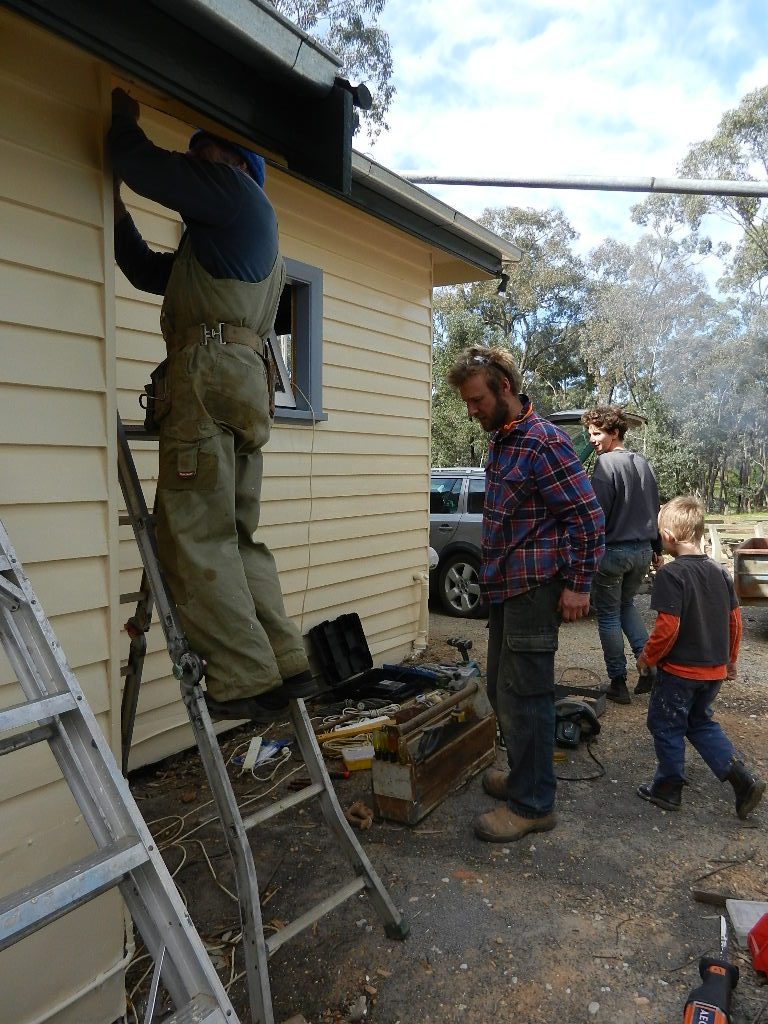
With the assistance of local tradespeople and experienced project management, grants, donations and volunteer effort, the initial building repair and restoration was completed within budget.
Acknowledgement: Ken James, A History of the Fryerstown State School No. 252. The historical narrative on this page is adapted from the school’s earlier website.